Citations & Trust
Celeredge treats citations and verification as first-class. The premise is simple: an AI finding you can't trace isn't worth putting in front of a client. So every AI output in Celeredge is grounded in real evidence and cited back to its source, with a confidence signal you can read at a glance.
Why this matters
Consulting runs on defensibility. When you tell a client "your procurement cycle time is a risk", you need to show where that came from. Celeredge builds that chain automatically: retrieve real evidence → generate the finding from it → cite the source → let anyone click through to verify.
The pieces
Evidence sources
Findings can be grounded in four kinds of evidence, and Celeredge keeps them honest rather than flattening them into one number:
| Source type | What it is | How its confidence reads |
|---|---|---|
| Document chunk | A passage retrieved from an uploaded document | A match score (e.g. "41% match") — how similar the passage is to the question |
| Database result (SQL) | A row computed from a connected database | Exact — it's a real query result, not an estimate |
| Signal | An AI-detected observation with a verbatim quote | Carries its source quote and link |
| Insight | A rated insight excerpt curated during the engagement | A rated confidence (e.g. "Rated 0.80") |
Confidence pill
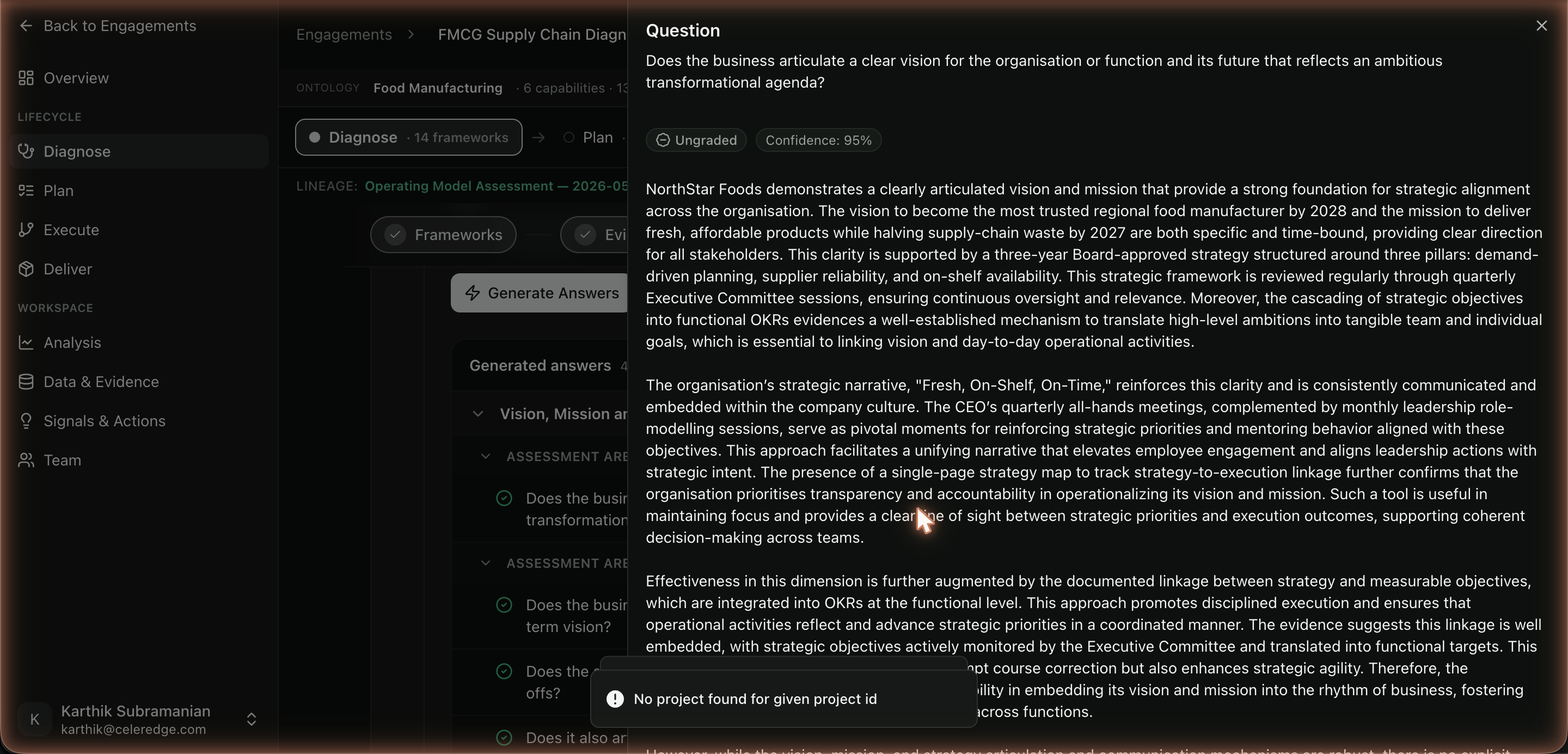
Wherever an answer appears, a confidence pill summarizes how well-grounded it is, in four bands:
| Band | Meaning |
|---|---|
| Not grounded | No supporting evidence was found |
| Low | Below 0.5 |
| Medium | 0.5 – 0.8 |
| High | 0.8 and above |
The honesty rule: if an answer has zero evidence, its pill shows Not grounded — regardless of any model-stated confidence. An answer cannot claim to be confident with no evidence behind it. This is enforced end to end, not just in the display.
Citation rows
Each cited answer lists its sources. Every citation row shows:
- a source-type chip (document / database / signal / insight),
- a score badge read according to its kind (
41% match,Rated 0.80, orExact), - a click-to-expand excerpt of the actual source text,
- an "Open source" link that deep-links into the Evidence Vault, scrolls to the exact record, and highlights it.
No-evidence is shown, not hidden
If a question turns up no supporting evidence, Celeredge displays an explicit "No supporting evidence found" state rather than silently showing an unsupported answer. Absence of evidence is information, and you see it.
How grounding works (in plain terms)
- Your documents and connected data are indexed when you add them to an engagement.
- For each assessment question or query, Celeredge retrieves the most relevant evidence.
- The answer is generated from that evidence — and clamped to Not grounded if none was found.
- Each answer is cited with sources, scores, and excerpts.
- When you accept answers, the evidence is saved as durable Evidence Records in the Evidence Vault, creating a permanent audit trail.
Traceability end to end
Because of lineage, the chain doesn't stop at a single answer. A claim in a delivered report traces to the assessment answer, which traces to its cited evidence, which traces to the original document or query. You can defend any number in the deck back to its origin.
How to trust an output — a checklist
- Read the confidence pill first. Not grounded or Low means treat the answer as a draft.
- Open the citations. Expand the excerpt and confirm it actually supports the claim.
- Click "Open source". For anything client-facing, verify against the original in the vault.
- Prefer Exact for numbers. Database-derived KPIs carry their query — the most defensible numbers.
- Strengthen evidence and re-run. Low grounding usually means thin evidence; add documents or connect data and run again.
Related
- Evidence Vault
- Signals — the reference example of grounded, cited output
- Ask the Data
- Running Assessments