Plan
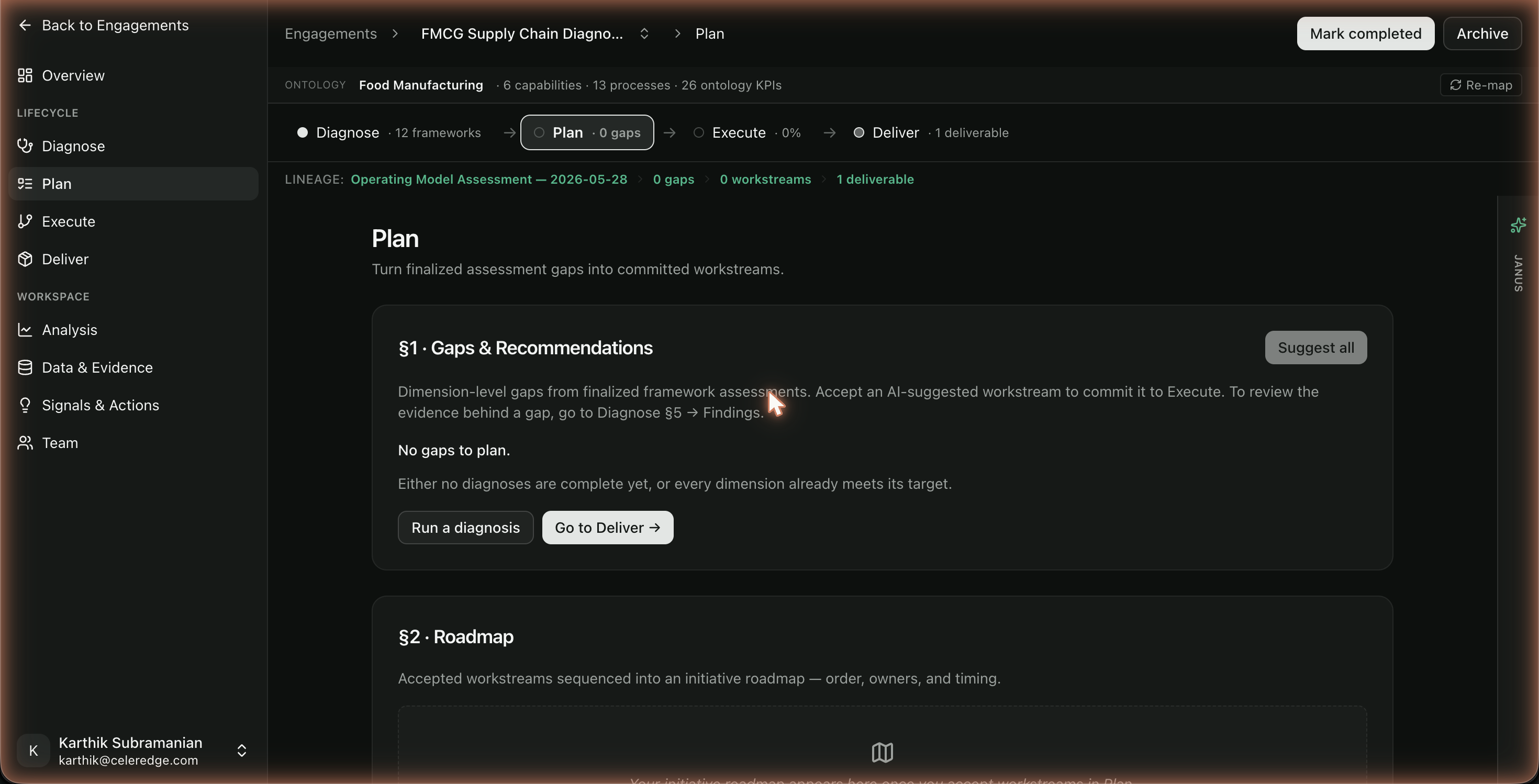
Plan is the second lifecycle phase. It converts the gaps surfaced in Diagnose into committed work: workstreams and a sequenced roadmap.
Who can access
Members of the engagement team.
How it works
Plan has three sections.
| Section | What it does |
|---|---|
| 1. Gaps & Recommendations | Review the gaps from Diagnose with AI-suggested workstreams; accept and commit them to Execute |
| 2. Roadmap | Sequence the committed initiatives with owners and timing |
| 3. Database KPIs | Live KPIs computed from connected databases, each backed by a verifiable SQL query |
Two kinds of KPI, don't confuse them. Database KPIs here are computed live from a connected database and each carries the exact query that produced them. Financial-document KPIs (from uploaded spreadsheets) live separately under Analysis → Ask the Data.
Step by step
- Review gaps. Open section 1. Each gap from Diagnose appears with one or more AI-suggested workstreams.
- Accept workstreams. Accept the recommendations you want to act on. Accepted workstreams commit to the Execute phase, carrying a lineage link back to their source gap.
- Build the roadmap. In section 2, sequence the initiatives, assign owners, and set timing.
- Review database KPIs. In section 3, review the live KPIs from any connected database. Each KPI shows the verifiable query behind it, so the number is defensible.
Best practices
- Commit deliberately. Accepting a workstream is a commitment that shows up in Execute — accept what the team will actually deliver.
- Sequence for dependencies. Use the roadmap to order workstreams so prerequisites land first.
- Verify KPIs at the source. Because each database KPI carries its query, spot-check the query logic before putting a number in front of a client.
Common errors
| Symptom | Likely cause | What to do |
|---|---|---|
| No gaps to plan | Gaps weren't sent from Diagnose | Return to Diagnose, accept answers, and "Send gaps to Plan" |
| Database KPIs empty | No database connected to the engagement | Connect one in Data & Evidence → Connected sources |
Related
- Diagnose — where gaps come from
- Execute — where committed workstreams are delivered
- Database connections
- Gap Analysis